PERU'S STEREOTYPES


Two stereotypes of Peruvian people are:
- All Peruvians are of the same race (Indian)
- Peruvian people are transported in "llamas"
In contrast with the stereotypes and the first picture, we can see in the second picture that in Peru there are a mix of race and the transportation in Peru is through buses, car an cycle as in most countries in the world.
THE TOOMEY MODEL

- FOOD:

- DRESS:

The women in Peru wear a colorful skirts made of cotton. The men in Peru use hats made of straw to protect themself of the sun. Both of them use colorful tunics.
- VALUES:

- According with some researchers, the values most practiced in Peru are solidarity, creativity and patriotism. The values least practiced by Peruvian people are honesty, discipline and respect.
- RULES:

All Peruvians have to honor to your country and protect the national interest. Also, the Peruvian people have to respect, to keep and to defend the constitution of Peru.
COMPARISSON WITH COLOMBIA

- COLOMBIA:
POWER DISTANCE:
At 67 Colombia scores high on the scale of the PDI, so it is a society that believes that inequalities amongst people are simply a fact of life. This inequality is accepted in all layers of society, so a union leader will have a lot of concentrated power compared to his union management team, and they in turn will have more power than other union members. A similar phenomenon will be observed among business leaders and among the highest positions in government.
INDIVIDUALISM:
At a score of 13 Colombia is amongst the lowest Individualist scores; in other words, it lies amongst the most collectivistic cultures in the world, beaten only by Ecuador, Panama and Guatemala.
Since the Colombians are a highly collectivistic people, belonging to an in-group and aligning yourself with that group’s opinion is very important. Combined with the high scores in PDI, this means that groups often have their strong identities tied to class distinctions. Loyalty to such groups is paramount and often it is through “corporative” groups that people obtain privileges and benefits which are not to be found in other cultures. At the same time, conflict is avoided, in order to maintain group harmony and to save face.
MASCULINITY:
At 64 Colombia is a Masculine society – highly success oriented and driven. Colombians are competitive and status-oriented, yet collectivistic rather than Individualist. This means that competition is directed towards members of other groups (or social classes), not towards those who are perceived as members of your own in-group.
People seek membership in groups which give them status and rewards linked to performance, but they often sacrifice leisure against work, as long as this is supported by group membership and by power holders.
UNCERTAINTY AVOIDANCE:
At 80 Colombia has a high score on Uncertainty Avoidance which means that as a nation they are seeking mechanisms to avoid ambiguity. Emotions are openly expressed; there are (extensive) rules for everything and social conservatism enjoys quite a following. This is also reflected in religion, which is respected, followed by many and conservative. Rules are not necessarily followed, however: this depends on the in-group’s opinion, on whether the group feels the rules are applicable to their members and it depends, ultimately, on the decision of power holders, who make their own rules. In work terms this results in detailed planning that may not necessarily be followed in practice.
LONG TERM ORIENTATION:
With a low score of 13, Colombian culture is classified as normative. People in such societies have a strong concern with establishing the absolute Truth; they are normative in their thinking. They exhibit great respect for traditions, a relatively small propensity to save for the future, and a focus on achieving quick results.
INDULGENCE:
Scoring a very high 83 in this dimension, Colombia is shown to be an Indulgent country. People in societies classified by a high score in Indulgence generally exhibit a willingness to realise their impulses and desires with regard to enjoying life and having fun. They possess a positive attitude and have a tendency towards optimism. In addition, they place a higher degree of importance on leisure time, act as they please and spend money as they wish.
- PERU:
POWER DISTANCE:
There is ample evidence for Peru´s high PDI score of 67 at organisational level. In general, it is possible to find rather tall, centralised structural arrangements. By the same token, there are larger proportions of supervisory personnel and wage differentials.
Some observers trace back Peru´s PDI score to the tightly structured and centralized Inca empire; others point out that it has been fostered by colonial and authoritarian governments as well as the church. However, subordinates still perceive superiors as difficult to access and do not trust them. Superiors consider subordinates as being of a different kind and ask for respect – particularly if the latter are of black or indigenous origin.
INDIVIDUALISM:
With a value of 16 Peru shows a very collectivistic score, in line with most other Latin American countries. Among other consequences, it is interesting to highlight that in general people here find large companies attractive and that, particularly among blue collar workers, the involvement with the company is moral – and not calculative. Managers endorse more traditional points of view and only slowly start supporting employee initiative and group activity. In general they aspire to conformity and prefer having security over having autonomy in their position.
MASCULINITY:
At 42 Peru is a rather Feminine society. This trait has been the source of many cultural clashes and misunderstandings. For expatriates, locals were aloof or downright lazy. The actual reasons, however, were the locals weaker achievement motivation, their preference for human contacts and family over recognition or wealth, and the marginal role awarded to work by large sectors of the population.
UNCERTAINTY AVOIDANCE:
At 87 Peru scores high on UAI – and so do the majority of Latin American countries that belonged to the Spanish kingdom. These societies show a strong need for rules and elaborate legal systems in order to structure life. The individual’s need to obey these laws, however, is weak. Corruption is widespread, the black market sizeable and, in general, you´ll see a deep split between the “pays réel” and the “pays légal”.
LONG TERM ORIENTATION:
With a low score of 25, Peruvian culture is more normative than pragmatic. People in such societies have a strong concern with establishing the absolute Truth; they are normative in their thinking. They exhibit great respect for traditions, a relatively small propensity to save for the future, and a focus on achieving quick results.
INDULGENCE:
One challenge that confronts humanity, now and in the past, is the degree to which small children are socialized. Without socialization we do not become “human”. This dimension is defined as the extent to which people try to control their desires and impulses, based on the way they were raised. Relatively weak control is called “Indulgence” and relatively strong control is called “Restraint”. Cultures can, therefore, be described as Indulgent or Restrained.
Peru has an intermediate score of 46 on this dimension.
THE LEWIS MODEL

According to the Lewis model, people is Peru is multi-active. For that reason, if a peruvian come to Barranquilla some problems that this person will have are problems with schedule because multi-active people is very flexible, problems with the communication because both are talkative and the interruptions in multi-active people are common.
SUBCULTURES- PUNK:

In the 2000s approximately, there was a boom of concerts called underground. Bands with a few diffusion by media because their lyrics contains protest, social disagreement,among others. Something rejected for many people.
With their own resources and with the name 'punk' the members of these bands organized concerts at low cost in urban zones mainly in the center of Lima.

HIPPIE:
This movement began in 70's in Peru. They began to see, in the center of Miraflores, in Barranco and Cusco. They were young people with long hair and leafy beards and tunics. Few of them lived in community, as real hippies do.
- CHAPRA:
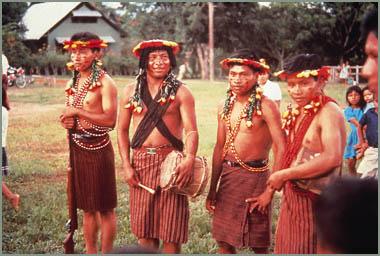
The Cndoshis or chapras are an amazonian ethnicity that live in the riversides of the Huitoyacu, Chapuli, Morna and Pastaza, Alto Nucuray and Lgo Rimachi (Musa Karusha) in the region of Loreto in Peru. Thei language is candoshi.

No hay comentarios:
Publicar un comentario